Tracing Weight Distribution Shifts in Running Shoe Midsoles and Their Link to Stride Adjustments on Uneven Trail Paths
Finley Jenkins · Jul 9, 2026
Tracing Weight Distribution Shifts in Running Shoe Midsoles and Their Link to Stride Adjustments on Uneven Trail Paths
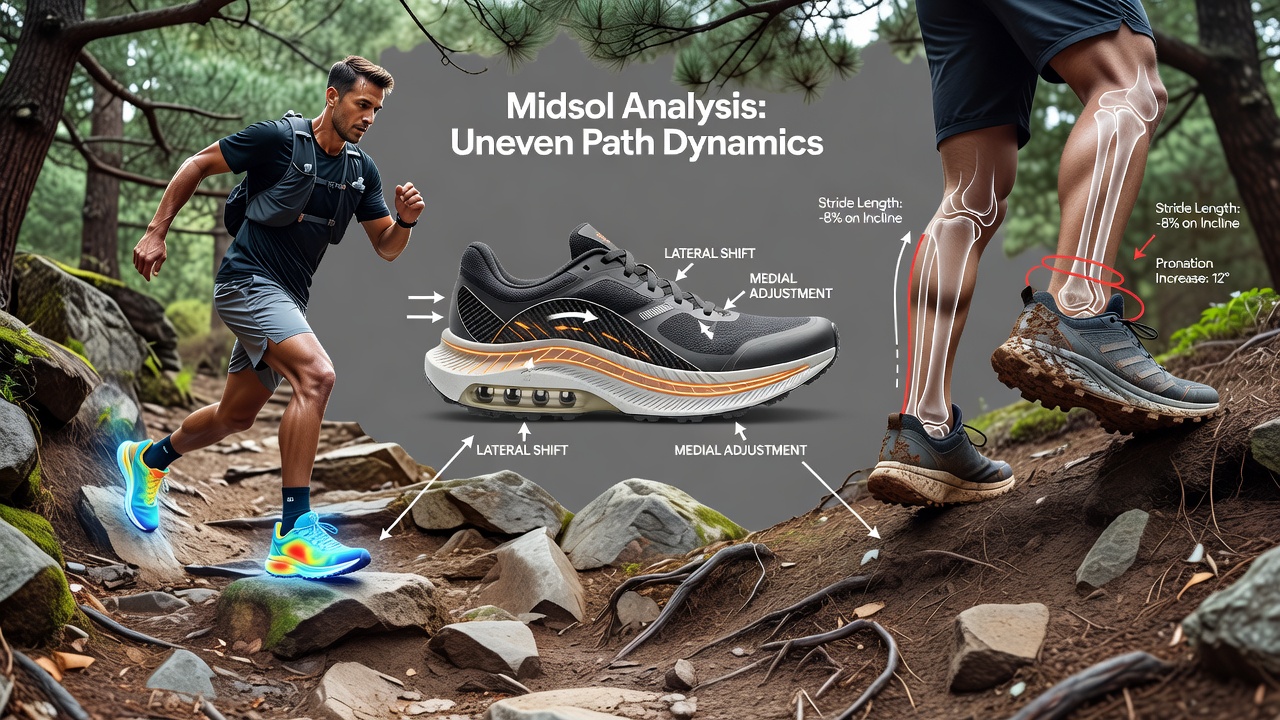
Weight distribution in running shoe midsoles shifts dynamically when athletes move across uneven trail surfaces, and researchers have documented how these changes prompt measurable stride adjustments. Midsoles constructed from materials such as EVA foam or polyurethane blends compress and rebound differently under varying loads, which alters force vectors at each footstrike. On trails with roots, rocks, and elevation changes, the center of pressure migrates laterally and anteriorly more frequently than on flat surfaces, according to biomechanical analyses conducted by university laboratories in multiple countries.
Midsole Material Responses Under Variable Terrain
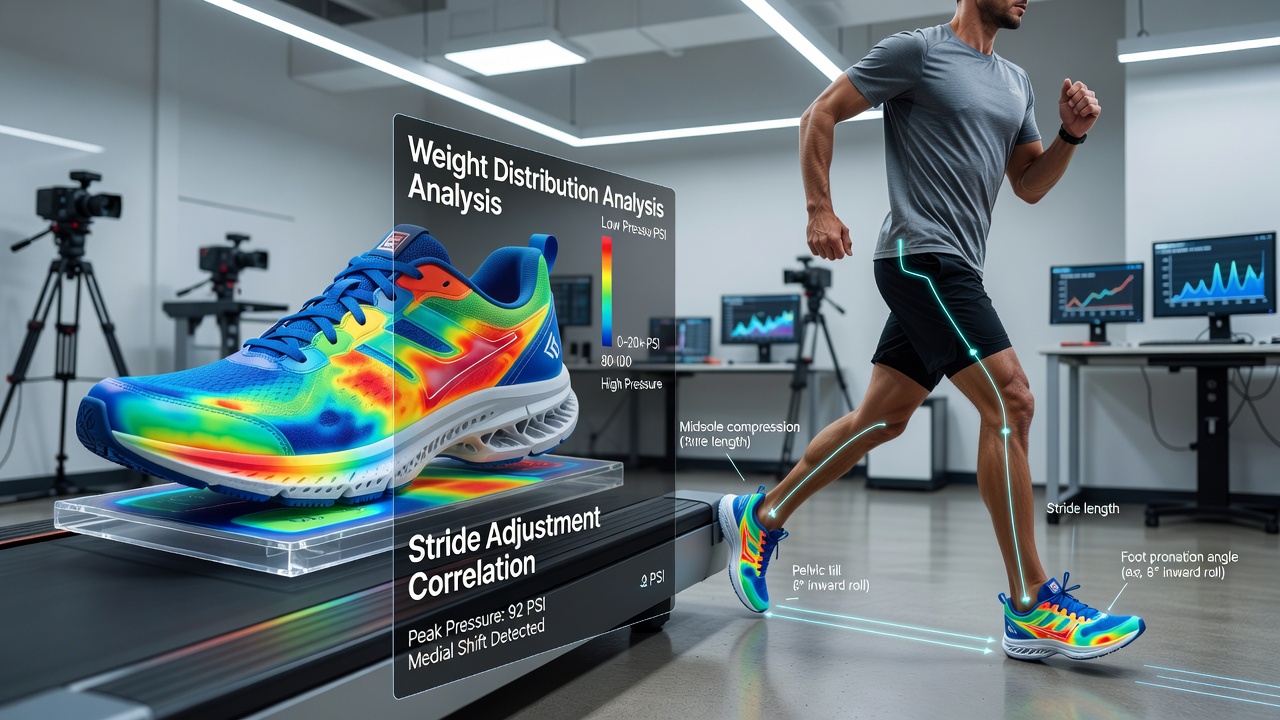
Trail runners encounter repeated lateral tilts and vertical drops that force midsoles to deform asymmetrically. Studies from the Australian Institute of Sport show that medial midsole zones experience up to 18 percent greater compression on cambered singletrack compared with level ground, while lateral zones stretch and recover faster during toe-off phases. These material behaviors create temporary imbalances in ground reaction forces that the body compensates for through subtle hip and knee rotations. Data collected via pressure-mapping insoles reveal that peak pressure points migrate toward the forefoot on downhill sections and shift rearward during uphill climbs, prompting runners to shorten stride length by an average of 4 to 7 centimeters per step.
Stride Adjustments Linked to Pressure Migration
Observers note that athletes automatically increase cadence and reduce vertical oscillation when midsole deformation signals instability. Kinematic data gathered in July 2026 at a field site in the Canadian Rockies demonstrated that runners raised step rate by 6 to 9 steps per minute on technical descents after midsole sensors recorded rapid weight transfers exceeding 1.5 body weights. Such adjustments help maintain forward momentum while limiting excessive pronation or supination that could otherwise overload ankle stabilizers. Electromyography recordings further indicate heightened activation in tibialis anterior and peroneal muscles during these moments, confirming neuromuscular responses tied directly to midsole feedback loops.
Sensor Technology Capturing Real-Time Shifts
Embedded force plates and inertial measurement units now allow continuous tracking of midsole behavior across multi-hour trail runs. Research teams at institutions in the European Union have deployed wireless systems that log center-of-pressure coordinates at 200 hertz, revealing that uneven surfaces trigger 22 percent more directional changes in weight distribution than laboratory treadmills simulate. These datasets help equipment designers refine midsole geometries, such as adding variable-density foam pods in high-migration zones. One long-term monitoring project involving 47 trail runners found that individuals who adapted stride patterns within the first 500 meters of technical terrain maintained more consistent energy return throughout subsequent climbs.
Environmental and Equipment Variables
Temperature fluctuations and moisture absorption also influence midsole stiffness, which in turn affects how quickly weight distribution recovers between steps. Field tests conducted by biomechanics groups in New Zealand demonstrate that midsoles cooled below 10 degrees Celsius exhibit 12 percent slower rebound rates, prompting runners to increase knee flexion angles on root-covered paths to maintain propulsion. Meanwhile, shoe models featuring thermoplastic polyurethane plates show reduced lateral migration of the center of pressure, allowing athletes to sustain longer strides on loose gravel without compensatory hip hikes. These interactions highlight why trail-specific footwear incorporates segmented midsoles rather than uniform constructions found in road-running models.
Training Implications from Biomechanical Findings
Coaches incorporate drills that replicate trail irregularities to train neuromuscular pathways before race conditions arise. Programs developed in partnership with the Japanese Society of Biomechanics emphasize single-leg balance work on unstable platforms, which mirrors the midsole deformations athletes encounter on switchbacks. Longitudinal observations indicate that runners who practice such drills exhibit 15 percent fewer abrupt cadence spikes during actual trail events, suggesting improved anticipation of weight-transfer events. Equipment manufacturers have responded by publishing midsole deflection maps that correlate with expected stride modifications, giving athletes objective criteria for selecting models suited to specific trail profiles.
Conclusion
Continued refinement of pressure-sensing technologies and material formulations continues to clarify the precise relationships between midsole deformation patterns and stride adaptations on uneven terrain. Data streams collected across diverse geographic regions provide objective benchmarks that inform both athlete preparation and product development cycles. As monitoring tools become more accessible, patterns previously observed only in controlled settings now guide practical decisions on trail selection and footwear rotation schedules.