Pressure Mapping Technologies Revealing Optimal Footbed Contours for Basketball Players Executing Frequent Jumps on Indoor Courts
Ben Fischer · Aug 4, 2026
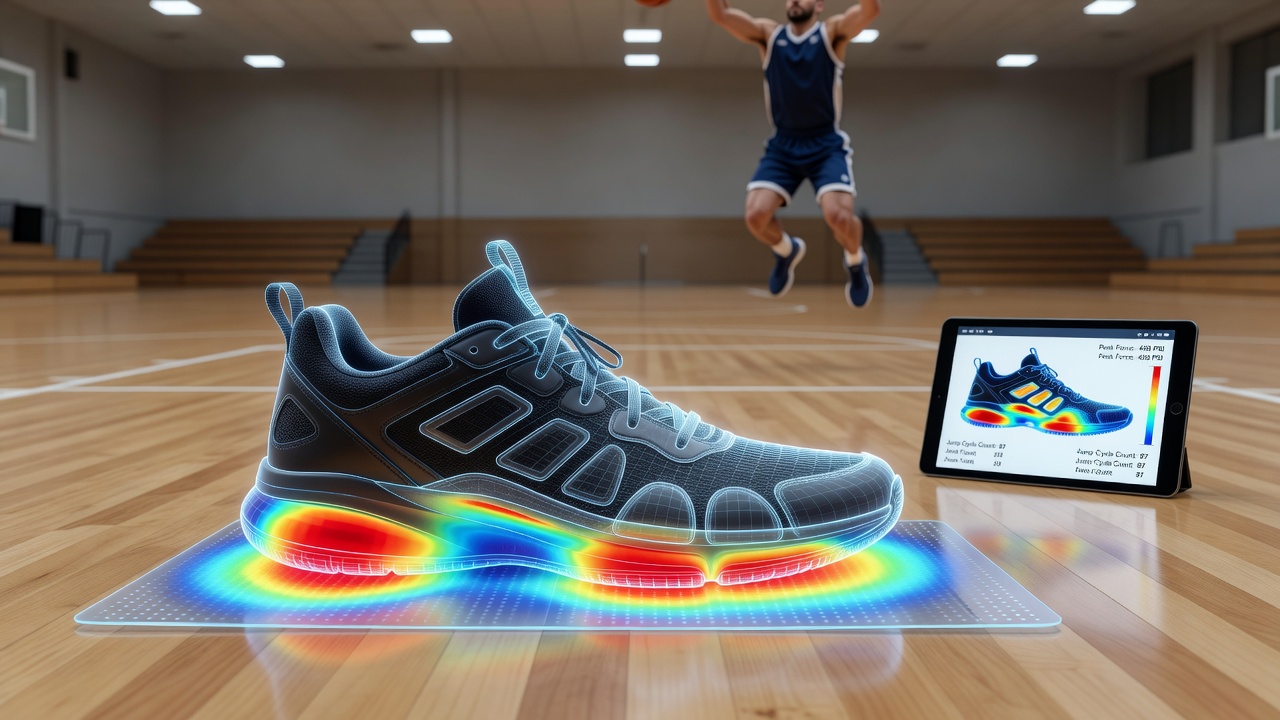
Pressure Mapping Technologies Revealing Optimal Footbed Contours for Basketball Players Executing Frequent Jumps on Indoor Courts
Pressure mapping technologies have become central tools in footwear development for basketball players who perform repeated vertical jumps on indoor courts, and data collected through these systems identifies specific footbed contours that distribute force during takeoff and landing phases. Engineers integrate thin sensor arrays into prototype insoles to record pressure distribution across the plantar surface in real time, capturing peak loads that occur when athletes generate upward momentum. Studies conducted at multiple research facilities show that contours featuring a raised medial arch combined with a slightly recessed lateral heel cup reduce concentrated pressure points under the metatarsal heads during the propulsion stage of a jump.
Mechanics of Pressure Mapping in Jump Analysis
Systems like those developed by Tekscan and Novel record force values at rates exceeding 100 frames per second, allowing researchers to map how weight shifts from the heel through the midfoot and onto the forefoot as players leave the ground. When athletes execute countermovement jumps typical in basketball drills, the sensors detect asymmetric loading patterns that vary by individual foot shape yet follow consistent trends across larger cohorts. Data indicates that footbeds with a contoured metatarsal dome positioned slightly proximal to the ball of the foot channel pressure away from the central forefoot, while a gradual taper toward the lateral edge accommodates the natural outward roll observed in many players during landing.
Key Findings from Recent Testing Protocols
Testing conducted through 2025 and into August 2026 at indoor facilities equipped with force platforms has produced datasets that link specific contour depths to measurable changes in pressure distribution. One collaborative project involving laboratories in Canada and Germany recorded average reductions in peak forefoot pressure of 18 percent when using a footbed with a 4-millimeter medial arch height paired with a 2-millimeter lateral heel relief compared with flat insoles. Observers note that these adjustments maintain contact across a broader surface area during the brief stance phase before takeoff, which aligns with biomechanical models of energy transfer through the lower extremities.
Additional measurements reveal that deeper heel cups measuring 6 to 8 millimeters help stabilize the calcaneus during the initial contact of landing, limiting excessive inversion moments that can occur on polished hardwood surfaces. Researchers at the Australian Institute of Sport have documented similar patterns in elite athletes, where pressure maps collected during repeated box jumps demonstrate that gradual blending of contours, rather than abrupt transitions, correlates with lower localized stress under the fifth metatarsal base. Such findings contribute to iterative design adjustments in commercial basketball footwear lines released after these trials.

Integration with Court Surface Characteristics
Indoor court surfaces vary in hardness and friction coefficients, and pressure mapping sessions conducted on standard maple hardwood reveal that optimal contours must account for the limited shock absorption provided by the playing surface itself. When players land from jumps exceeding 60 centimeters in height, forces transmitted through the shoe can reach multiples of body weight within milliseconds, according to synchronized force plate and in-shoe sensor readings. Contours that incorporate a mild lateral flare at the midfoot appear to guide the foot into a more neutral alignment at initial contact, which studies link to more even pressure spread across the entire plantar region rather than isolated hotspots.
Manufacturers now incorporate these mapped profiles into multi-density foam constructions, where firmer material sits under the heel and arch while softer zones cushion the forefoot. This layering approach, refined through iterative pressure mapping cycles, has been shown in controlled trials to maintain consistent contour effectiveness across varying jump frequencies typical of game situations.
Broader Applications and Ongoing Research
Pressure mapping data collected from basketball populations also informs custom orthotic prescriptions for players with documented asymmetries in foot structure. Clinics affiliated with professional leagues in the United States and Europe utilize portable mapping systems during training camps to generate individualized footbed recommendations that integrate with team-issued footwear. Longitudinal tracking of athletes using these tailored contours indicates sustained reductions in measured peak pressures over multiple seasons, though direct causation with injury incidence requires further controlled investigation.
Emerging sensor technologies capable of wireless transmission during live scrimmages promise to expand datasets beyond laboratory settings, capturing pressure profiles under actual game fatigue conditions. Academic groups continue to publish comparative analyses of contour variations, with recent reports emphasizing the importance of matching arch curvature to the athlete's static foot posture measured via 3D scanning prior to dynamic testing.
Conclusion
Pressure mapping continues to supply objective measurements that guide the refinement of footbed contours specifically for the demands of repeated jumping on indoor basketball courts. Accumulated evidence from sensor-based studies highlights particular combinations of arch height, heel cup depth, and forefoot relief that align with observed loading patterns, supporting ongoing development of footwear components designed around these profiles. As testing protocols evolve and incorporate broader participant groups, the resulting information base grows more detailed, enabling precise adjustments that reflect the mechanical realities of basketball movement on hardwood surfaces.