Polymer Coatings on Golf Ball Dimples Shape Spin Control Across Wind Conditions
Tina Schwarz · Aug 13, 2026
Polymer Coatings on Golf Ball Dimples Shape Spin Control Across Wind Conditions
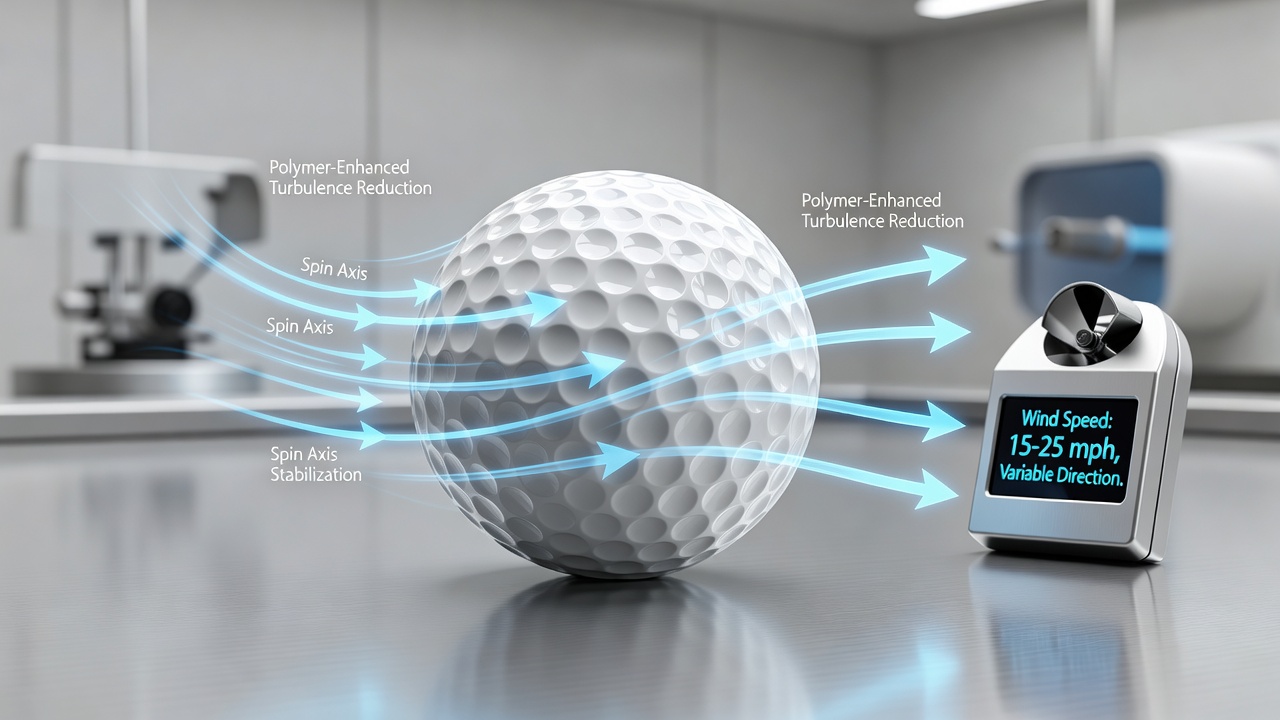
Golf ball manufacturers apply polymer coatings to dimple surfaces to modify airflow patterns and manage spin rates when balls travel through changing wind environments, and researchers have documented these effects through wind tunnel testing and on-course data collection since the early 2000s. Dimples already reduce drag by creating a thin turbulent boundary layer around the ball, yet the addition of specialized polymer layers alters the friction coefficient at the dimple edges, which influences how the ball rotates after impact with the clubface. Studies from materials science laboratories show that coatings with specific viscoelastic properties maintain consistent grip on the club while allowing controlled release during flight, resulting in spin rates that adjust more predictably when crosswinds or tailwinds push the ball off its intended path.
Dimple Geometry Meets Polymer Chemistry
Standard dimple patterns consist of between 300 and 500 indentations arranged in geometric layouts that manufacturers refine through computational fluid dynamics, and polymer coatings add a microscopic layer that changes surface energy without altering the overall dimple depth or diameter. These coatings typically incorporate polyurethane or acrylic blends that cure to form films between 5 and 20 micrometers thick, and data from manufacturers indicate that such films reduce micro-abrasion during repeated impacts while preserving the aerodynamic boundary layer separation points. Observers note that when wind speeds exceed 15 kilometers per hour, the coated dimples help stabilize spin axis tilt because the polymer reduces erratic torque forces that uncoated surfaces sometimes generate upon contact with moisture or dust particles.
Spin Behavior in Variable Wind Environments
Headwinds increase effective airspeed and can amplify backspin, whereas crosswinds introduce side forces that cause the ball to curve if spin rates exceed design thresholds, and polymer coatings help moderate these responses by fine-tuning the Magnus effect through controlled surface friction. Research conducted at facilities in North America and Europe demonstrates that balls with optimized polymer treatments exhibit spin decay rates that remain within 200 revolutions per minute of target values across wind gusts ranging from 5 to 25 kilometers per hour. The coatings achieve this stability because their molecular structure resists temperature-induced softening during warm conditions and maintains elasticity when temperatures drop, allowing the dimple edges to interact with airflow in a repeatable manner regardless of external humidity levels.

Testing Protocols and Performance Metrics
Engineers evaluate coated golf balls using robotic launchers inside climate-controlled wind tunnels that replicate gust patterns recorded during professional tournaments, and results from these trials feed directly into adjustments for cover stock formulations. According to documentation released by the United States Golf Association, spin measurements collected under standardized wind conditions help verify that balls conform to overall distance and symmetry regulations while allowing manufacturers to differentiate products through proprietary coating chemistries. In August 2026 several testing facilities updated their protocols to include variable humidity cycles that more closely mirror coastal and inland course environments, revealing that certain polymer blends retain spin consistency even after exposure to salt-laden air for multiple rounds.
Material Selection and Manufacturing Integration
Production teams apply polymer coatings through spray or dip processes followed by ultraviolet curing stages that bond the material to the ionomer or urethane cover beneath, and quality control teams measure coating thickness at multiple points on each dimple to ensure uniformity. Those who have examined production data note that even small variations in application temperature affect the final surface hardness, which in turn influences how much sidespin develops when players strike the ball with irons versus drivers. The integration step occurs after dimple molding but before final polishing, allowing the polymer to settle into micro-textures that enhance grip without adding measurable weight to the finished ball.
Comparative Data Across Wind Scenarios
Field studies compiled by research groups in Australia and Canada compare coated and uncoated balls launched into measured wind fields, and the compiled figures reveal that coated versions reduce lateral deviation by up to 12 percent when wind angles shift between 30 and 60 degrees relative to the target line. These outcomes arise because the polymer layer maintains a more constant coefficient of friction at the boundary layer interface, which limits the amplification of any initial spin axis misalignment caused by off-center strikes. Players and fitters who review launch monitor outputs frequently observe that the coated balls produce tighter dispersion patterns on days when wind direction changes between holes, supporting the value of consistent spin management across an entire round.
Conclusion
Polymer coatings applied to golf ball dimples provide measurable adjustments to spin characteristics that help balls maintain intended flight paths when wind conditions vary, and ongoing laboratory work continues to refine coating compositions for greater environmental resilience. Data gathered from controlled testing and tournament environments confirm that these surface treatments interact with established dimple geometries to deliver predictable performance metrics without violating equipment standards. As measurement technologies advance, manufacturers gain additional precision in tailoring coatings to specific player profiles and course conditions, resulting in incremental improvements that accumulate across competitive play.