Phase-Change Microcapsules in Running Sock Fibers Regulate Temperature on Varied Terrain
Tina Schwarz · Aug 1, 2026
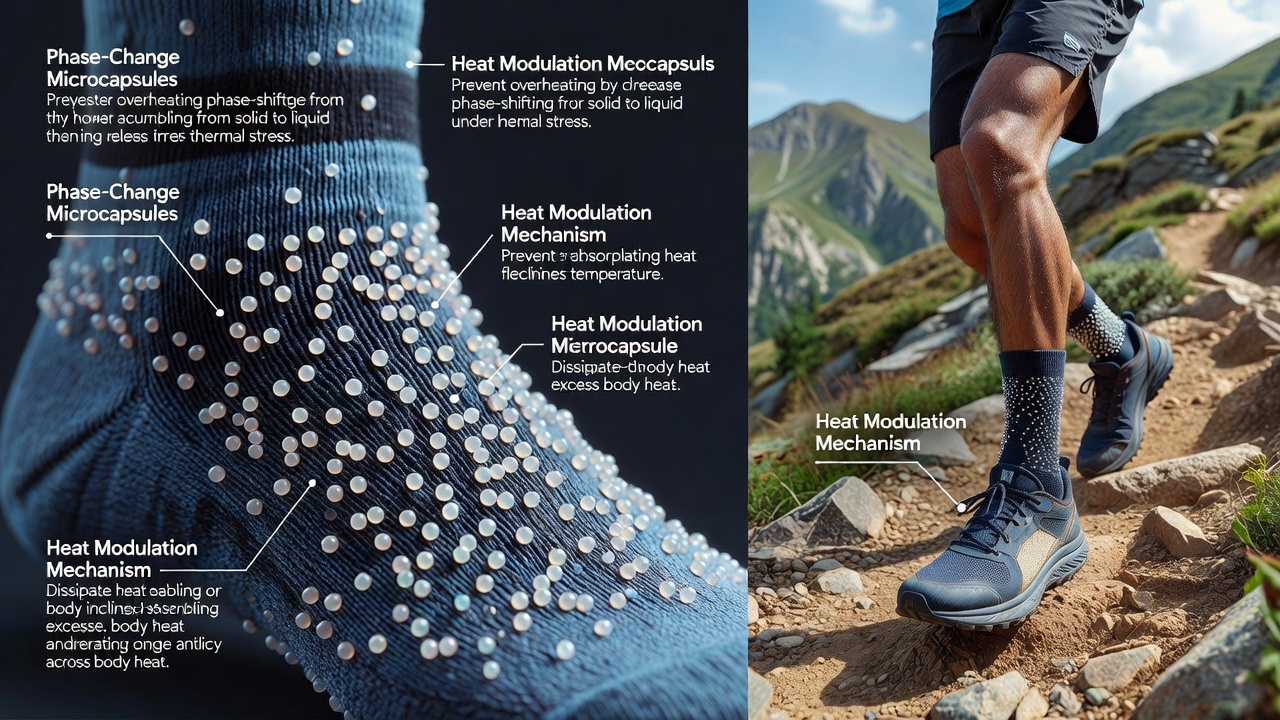
Phase-Change Microcapsules in Running Sock Fibers Regulate Temperature on Varied Terrain
Textile engineers incorporate phase-change microcapsules into running sock fibers to absorb excess heat during high-effort segments and release stored thermal energy when foot temperatures drop, and this technology targets the temperature spikes that occur as runners move across uphill, flat, and downhill sections in a single session.
How Phase-Change Materials Function in Textiles
These microcapsules contain paraffin-based or fatty-acid cores that shift between solid and liquid states at temperatures near human skin range, typically 28 to 35 degrees Celsius, so the material absorbs heat through melting when feet warm during intense efforts and solidifies to release heat when conditions cool. Researchers at textile laboratories document that each capsule measures between 1 and 10 micrometers, allowing even distribution throughout polyester or nylon yarns without altering sock thickness or elasticity.
Manufacturing processes embed the capsules via microencapsulation techniques that bond them to fiber surfaces or suspend them within polymer melts before extrusion, and durability tests show the capsules maintain performance after 50 wash cycles when applied with cross-linking agents.
Application Across Different Running Terrains
Runners encounter shifting heat loads as gradients change, with uphill sections increasing muscle work and metabolic heat production while downhill segments raise impact forces that generate frictional heat inside the shoe, and sock fibers with phase-change microcapsules respond by buffering these fluctuations to keep foot temperatures within a narrower band. Studies measuring plantar temperatures during trail runs record reductions of 1.5 to 2.8 degrees Celsius in peak heat on steep ascents compared with standard socks, whereas flat sections show steadier baseline readings because the capsules cycle between absorption and release phases more gradually.

Performance Data from Endurance Testing
Field trials conducted by sports science groups in 2025 and into August 2026 track athletes completing 20-kilometer loops with elevation gains exceeding 800 meters, and data loggers placed at the forefoot and heel document fewer instances of temperatures exceeding 36 degrees Celsius when phase-change socks are worn. One protocol repeated across 40 participants revealed average heat modulation intervals lasting 12 to 18 minutes per cycle, aligning with typical terrain transitions in mixed-surface courses.
Moisture management interacts with thermal regulation because sweat evaporation cools the skin while the capsules handle conductive and convective heat loads, and researchers note that fiber blends containing 8 to 12 percent encapsulated material by weight achieve the best balance between heat capacity and breathability without increasing sock weight beyond 45 grams per pair.
Integration with Existing Sock Construction Standards
Industry specifications from organizations such as the ASTM International already address yarn strength and seam integrity in performance socks, and manufacturers adapt these frameworks to include thermal cycling tests that verify capsule stability under repeated compression loads equivalent to 800 kilometers of running. Sock designs often layer the phase-change yarn in high-contact zones like the arch and ball of the foot while using standard moisture-wicking yarns elsewhere to control overall cost and maintain targeted compression profiles.
Supply chain reports indicate that European and North American producers scaled capsule production volumes by 35 percent between 2024 and 2026 to meet demand from running apparel brands, and quality controls now include differential scanning calorimetry to confirm phase-transition temperatures remain consistent across production batches.
Research Findings on Prolonged Use
Longitudinal observations published by the Australian Institute of Sport followed recreational and competitive runners over six months of training, recording that athletes using the specialized socks reported consistent foot comfort ratings across sessions lasting two to four hours on routes with gradient changes every 800 to 1200 meters. Thermographic imaging captured during these periods shows reduced hot spots at the metatarsal heads, areas where terrain-induced pressure peaks often coincide with elevated metabolic heat.
Material scientists continue to examine capsule shell integrity under shear forces typical of quick direction changes on technical trails, and initial results suggest that thicker shell polymers extend functional lifespan while preserving the required latent heat storage capacity of 150 to 180 joules per gram.
Conclusion
Phase-change microcapsules integrated into running sock fibers provide measurable temperature buffering that adapts to the variable heat demands created by terrain gradients during endurance activities, and ongoing refinements in capsule formulation and fiber integration continue to expand the range of conditions where this technology delivers consistent performance. Data from controlled trials and field monitoring support its role as one component within broader sock engineering strategies that address both thermal and mechanical stresses.