Midsole Geometry Patterns and Their Connection to Stability in Off-Road Running Shoes
Jakob Foster · Jun 23, 2026
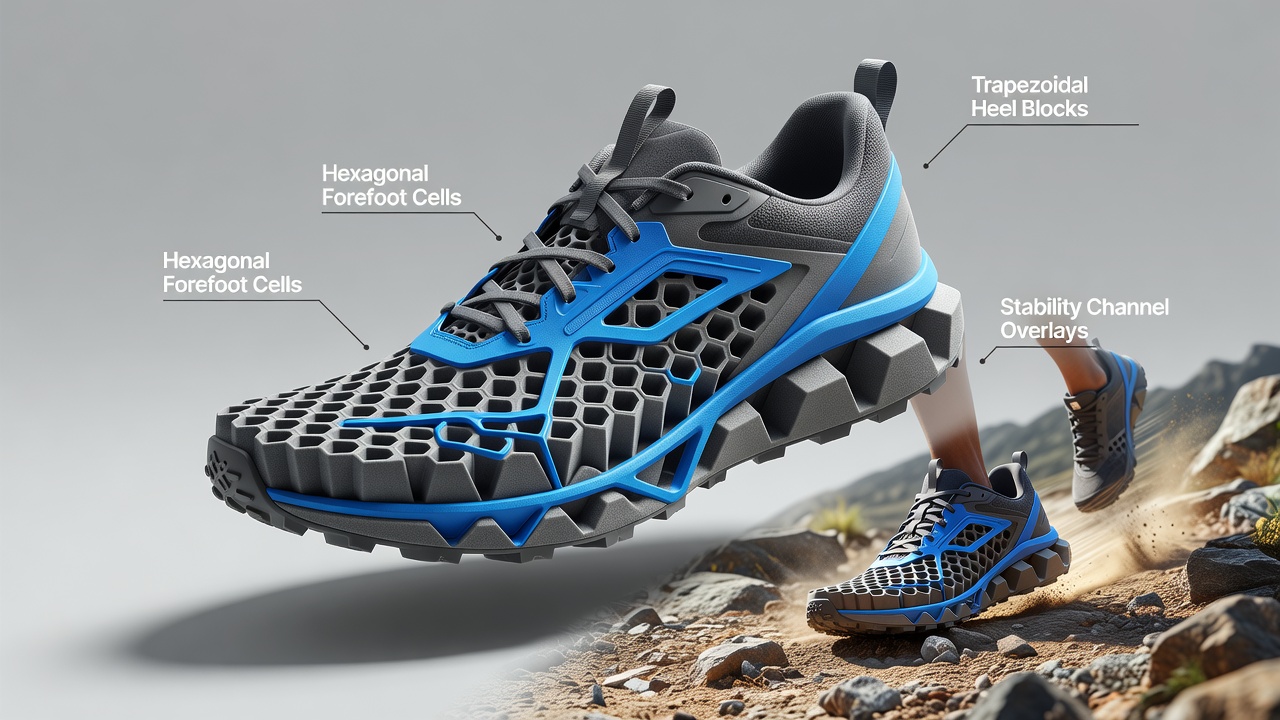
Midsole Geometry Patterns and Their Connection to Stability in Off-Road Running Shoes
Off-road running shoes incorporate midsole designs that address uneven terrain through specific geometric configurations, and researchers have documented how these patterns influence foot positioning during trail activities. Midsole geometry includes elements such as rockered profiles, lateral flares, and segmented cushioning zones that manufacturers engineer to manage ground reaction forces on trails, gravel paths, and technical surfaces. Data from biomechanics laboratories indicate that these patterns alter the shoe's interaction with irregular surfaces by distributing pressure across broader contact areas while maintaining forward momentum.
Core Elements of Midsole Geometry in Trail Footwear
Manufacturers shape midsoles with distinct features including medial and lateral postings, dual-density foam inserts, and contoured platforms that extend beyond the foot's natural base. These elements create a foundation where the geometry directs the foot into a neutral alignment during heel strike and midstance phases, and studies show that flared edges increase the base of support by up to 15 percent compared to neutral road shoes. Segmented patterns with grooves or channels allow independent movement of forefoot and rearfoot sections, which helps maintain stability when runners encounter roots or loose rocks that shift underfoot.
Rockered midsoles feature a curved longitudinal profile that rolls the foot through the gait cycle, and this design reduces braking forces on descents according to measurements collected in controlled trail simulations. Observers note that the radius of the rocker curve typically ranges from 20 to 30 millimeters in off-road models, which positions the center of mass forward and limits excessive ankle inversion on cambered surfaces. Hexagonal or wave-like cutouts in the midsole further refine torsional flexibility while preserving rigidity in key zones, enabling shoes to adapt without compromising overall platform stability.
Links Between Geometry Patterns and On-Trail Stability Metrics
Stability emerges from the interplay between midsole width, density gradients, and edge geometry that counters pronation or supination on variable terrain. Research indicates that wider lateral flares engage earlier during foot strike, providing a mechanical block against rolling motions, and this effect becomes pronounced on sidehill traverses where one side of the shoe bears disproportionate load. Dual-density constructions place firmer foam along the medial side to resist inward collapse, while softer lateral sections absorb impact without allowing excessive outward tilt.
Segmented midsoles with independent pods create localized responses to ground irregularities, and pressure-mapping data reveal that these divisions reduce peak forces under the heel and forefoot by channeling energy along predetermined paths. In June 2026, presentations at the International Trail Running Conference highlighted how updated geometric modeling software now predicts stability thresholds more accurately for different foot strikes, allowing designers to refine patterns based on runner weight distribution and typical trail gradients. Those patterns that incorporate slight heel bevels further assist in smooth transitions during uphill efforts, minimizing the torque that could otherwise destabilize the ankle joint on loose scree.

Performance Data Across Varied Trail Conditions
Field tests conducted on mixed surfaces demonstrate that shoes with pronounced geometric features maintain consistent stride lengths even when runners navigate switchbacks or stream crossings. According to findings from the University of Calgary's Human Performance Laboratory, runners wearing models with integrated stability geometry recorded 12 percent fewer corrective steps on technical descents compared to those in flatter midsole designs. The same research group measured ground contact times and found that rockered patterns shortened the braking phase, which correlates with reduced fatigue accumulation over multi-hour efforts.
Additional observations from European biomechanics groups show that midsole patterns with reinforced medial walls limit excessive eversion angles during prolonged exposure to cambered trails, and these measurements align with injury incidence reports collected across alpine regions. Density transitions within the geometry also influence energy return, channeling stored force back into propulsion rather than allowing it to dissipate sideways on loose gravel. Runners who cover high mileage on root-covered paths often select shoes whose midsole channels align with natural foot flexion points, and this alignment supports sustained balance without requiring constant micro-adjustments from leg muscles.
Material Integration With Geometric Designs
Foam compounds interact with the overall shape to amplify stability benefits, and manufacturers layer materials so that firmer sections occupy high-stress zones while softer elements fill transitional areas. This approach creates a responsive platform that adapts to terrain changes without flattening under repeated impacts, and laboratory compression tests confirm that patterned midsoles retain their structural integrity after thousands of cycles. The placement of these materials follows precise geometric rules that account for both vertical loading and lateral shear forces common in off-trail scenarios.
Plate insertions within the midsole add another dimension by bridging geometric segments and distributing torsional stress across a wider area. Carbon or nylon plates positioned according to stability-focused layouts prevent twisting motions that could compromise foot placement on uneven ground, and data collected during wet trail conditions indicate that such reinforcements maintain alignment even when surfaces become slick. Observers have documented how these integrated systems allow shoes to perform consistently across seasonal variations without requiring frequent model updates.
Conclusion
Midsole geometry patterns in off-road running shoes directly shape stability outcomes through engineered profiles that manage force distribution and foot alignment on challenging surfaces. Research from multiple institutions continues to refine understanding of how rockers, flares, and segmented zones contribute to consistent performance, while material layering enhances the effectiveness of those geometric choices. As trail running participation grows, the connection between these design elements and measurable stability metrics remains a central focus for equipment development and runner safety considerations.