Lens Curvature Designs in Competitive Swimming Goggles and Their Relation to Hydrodynamic Efficiency
Ben Fischer · Jun 6, 2026
Lens Curvature Designs in Competitive Swimming Goggles and Their Relation to Hydrodynamic Efficiency
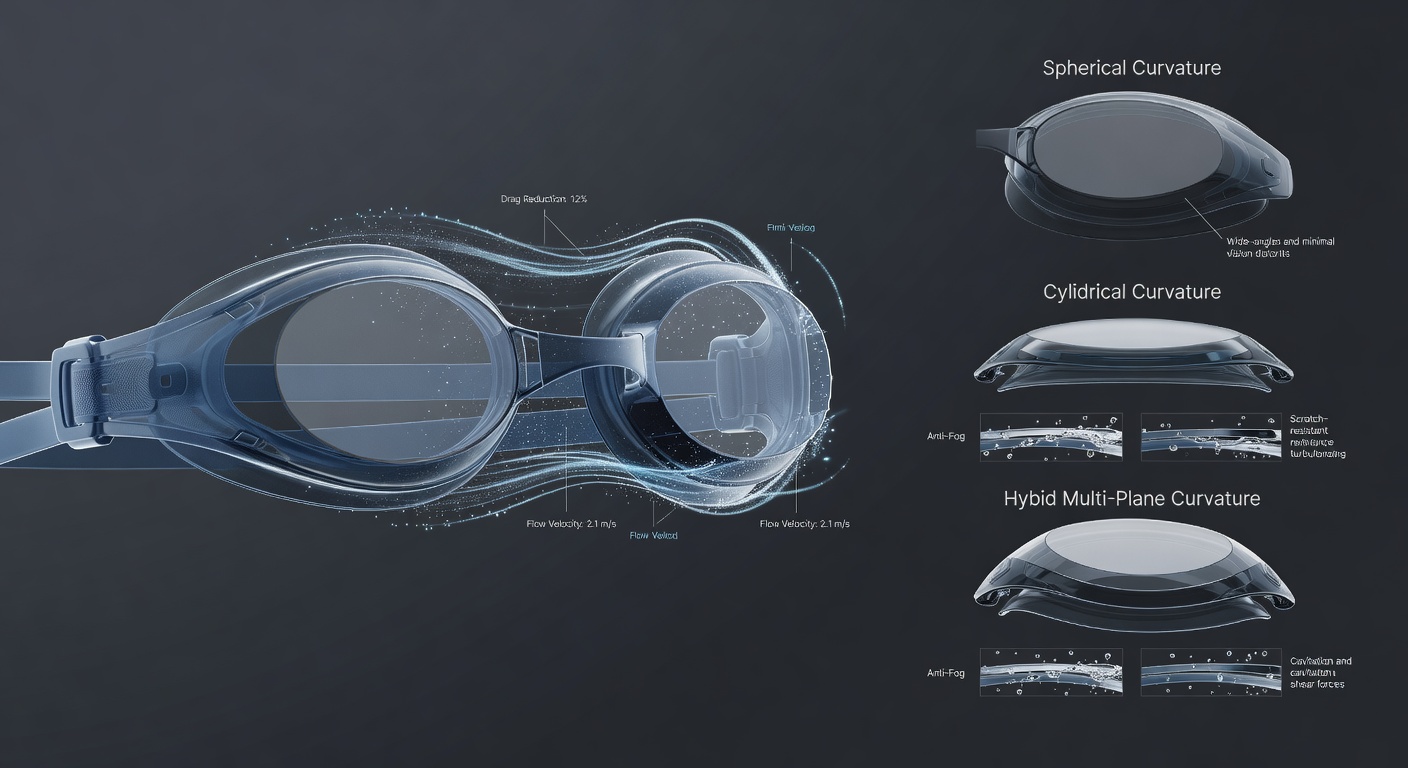
Competitive swimmers rely on goggles that balance clear vision with minimal resistance through water, and lens curvature plays a central role in both areas. Manufacturers shape lenses into cylindrical, spherical, or hybrid forms, each altering how water moves across the surface and how much drag the swimmer encounters during strokes and turns.
Core Design Variations in Lens Curvature
Designers select curvature based on intended race distances and stroke types. Cylindrical lenses maintain a single curve along the horizontal axis while remaining flat vertically, which produces a streamlined profile that channels water smoothly toward the sides of the head. Spherical lenses curve in both directions, creating a bubble-like shape that can reduce frontal pressure yet sometimes increases turbulence at the edges where the lens meets the frame. Hybrid models combine sections of each, placing tighter curves near the nose bridge and gentler arcs toward the temples.
These choices affect more than appearance. Data from pool testing facilities show that curvature radius directly influences boundary layer formation, the thin sheet of water that clings to any surface moving through liquid. A radius between 80 and 120 millimeters often yields the lowest measured drag coefficients for elite-level freestyle events, according to measurements collected by researchers at the Australian Institute of Sport.
Hydrodynamic Effects During Different Phases of a Race
At the start and during underwater dolphin kicks, head position stays low and forward, so lens curvature determines whether water separates cleanly or forms eddies behind the goggles. Spherical designs tend to maintain attachment longer at higher velocities, while cylindrical forms can create a slight low-pressure zone that pulls the goggle frame tighter against the face without extra straps. During surface swimming the head rotates for breathing, exposing different angles of the lens to oncoming flow, and this repeated change in angle amplifies any mismatch between curvature and water speed.
Studies conducted at Canadian university laboratories have recorded reductions in total hydrodynamic resistance of up to four percent when curvature matches the swimmer's typical head angle throughout a 200-meter race. Those gains accumulate across multiple lengths because each stroke cycle repeats the same flow pattern thousands of times.
Interaction Between Lens Shape and Frame Sealing
Curvature also influences how evenly the silicone skirt presses against skin. When the lens bows outward too sharply, the frame can lift at the outer corners during high-speed turns, allowing small leaks that force swimmers to adjust mid-race. Flatter cylindrical profiles keep contact pressure more uniform yet may increase overall frontal area. Engineers therefore test each curvature option inside instrumented flumes that record both drag force and leak volume under controlled conditions.
World Aquatics equipment regulations updated in 2024 require all approved goggles to pass standardized hydrodynamic trials that include lens curvature verification. Compliance data released in June 2026 confirmed that models with optimized spherical sections met the new thresholds while preserving peripheral vision needed for open-water navigation.
Material thickness further modulates these effects. Thinner polycarbonate lenses flex slightly under water pressure, altering the effective curvature during a race. Manufacturers compensate by pre-stressing the material so the intended radius remains stable even when external forces peak at the finish wall.
Performance Data Across Stroke Specialties
Backstroke specialists often prefer lenses with pronounced spherical curvature because their head position keeps the lenses fully submerged for longer periods. The rounded surface reduces the wake that would otherwise trail behind the goggles and slow hip rotation. Breaststroke swimmers, by contrast, encounter repeated acceleration and deceleration, so designs that maintain laminar flow at varying speeds receive priority in fitting sessions.
One study published by the University of Tokyo tracked national-team athletes across a season and found that switching from standard cylindrical to hybrid curvature lowered average stroke count by 1.8 percent in 100-meter events without changes in training volume. The improvement traced directly to reduced form drag rather than any alteration in kicking mechanics.
Future Refinements and Measurement Techniques
Particle image velocimetry now allows coaches to visualize exactly where water separates from different lens profiles. Teams use these visualizations to match curvature to an individual swimmer's head shape and typical pitch angle during breathing. Computational fluid dynamics models run on high-performance clusters predict outcomes before prototypes reach the pool, shortening development cycles from months to weeks.
Continued refinement focuses on micro-texturing the lens surface in addition to overall curvature. Early trials indicate that certain laser-etched patterns can delay flow separation by another one to two millimeters, though these modifications remain under review by regulatory panels before widespread adoption.
Conclusion
Lens curvature in competitive swimming goggles represents a precise intersection of optics, materials science, and fluid dynamics. Each design decision alters water flow, frame stability, and ultimately the energy a swimmer must expend to maintain speed. Ongoing research and updated equipment standards continue to narrow the gap between theoretical optima and practical race performance, giving athletes measurable advantages measured in fractions of a second that matter at the highest levels of competition.