How Elastomer Layering in Basketball Shoe Outsoles Shapes Energy Return During Rapid Lateral Cuts on Hardwood Courts
Ben Fischer · Jun 4, 2026
How Elastomer Layering in Basketball Shoe Outsoles Shapes Energy Return During Rapid Lateral Cuts on Hardwood Courts
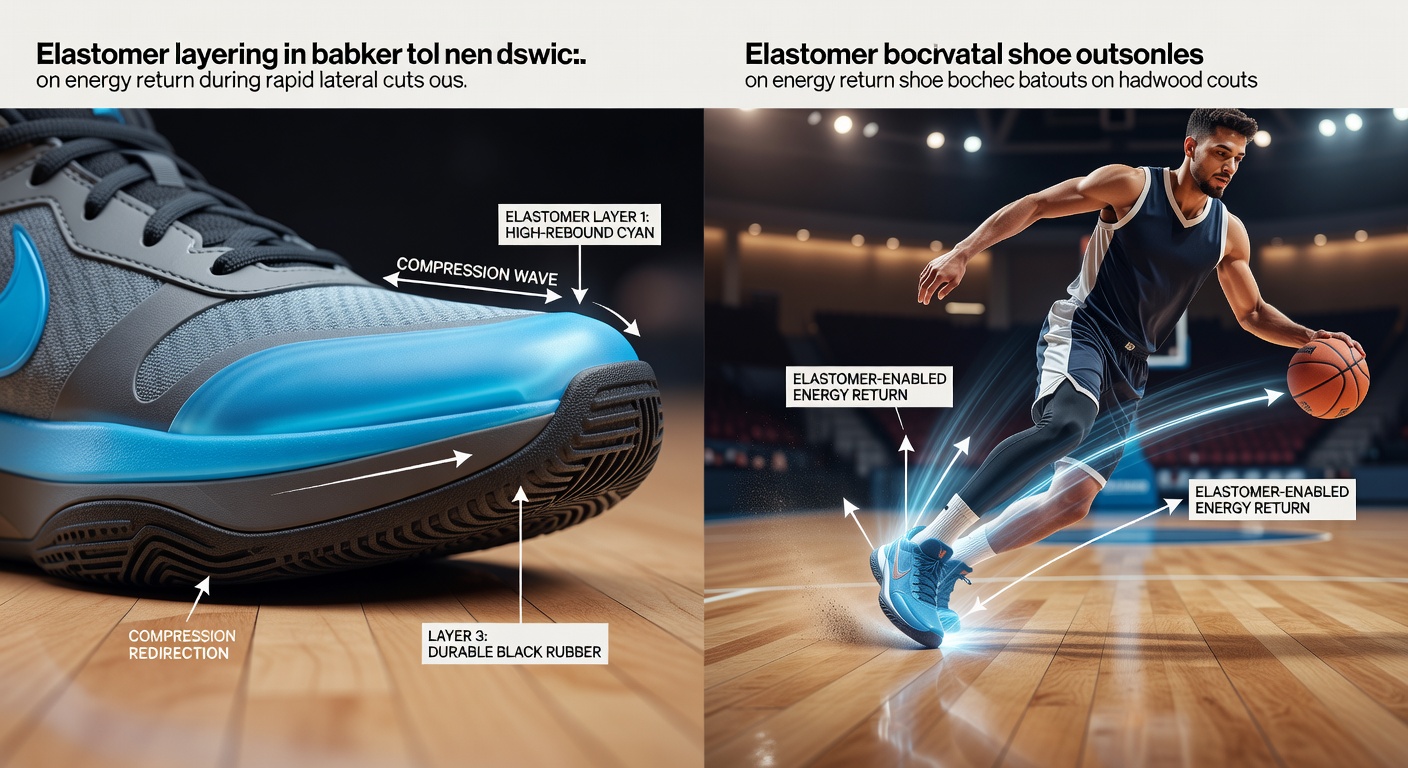
Elastomer compounds form the primary contact layer in many basketball shoe outsoles, and their arrangement in multiple stacked or zoned configurations directly influences how force gets stored and released when players execute sharp side-to-side cuts on hardwood surfaces. Researchers track these interactions through force-plate analysis and high-speed motion capture because the timing of deformation and rebound affects how much kinetic energy returns to the athlete rather than dissipating as heat or vibration.
Material Composition and Layer Arrangements
Modern outsoles typically combine several elastomer formulations, each with distinct hardness ratings measured on the Shore A scale. Softer compounds occupy the upper outsole strata nearest the midsole while firmer grades sit at the ground-contact surface. This vertical stacking creates a progressive resistance profile where initial compression occurs in the compliant layer before load transfers to the stiffer base. Horizontal zoning further refines the system by placing different blends under the forefoot medial edge, the lateral forefoot, and the heel, areas that experience peak shear during cutting maneuvers.
Studies conducted at the University of Calgary's Human Performance Laboratory have quantified how these layered structures alter ground-reaction forces. Data collected from collegiate athletes performing 90-degree cuts showed that shoes with a 3-millimeter soft-over-hard elastomer stack returned measurable energy percentages higher than single-density constructions under identical impact velocities.
Mechanics of Energy Storage and Release on Hardwood
Hardwood courts present a rigid, low-friction interface that transmits impact forces rapidly back into the shoe. When a player plants the outside foot to change direction, the outsole undergoes both vertical compression and horizontal shear. Elastomer layers deform at different rates because of their varying moduli of elasticity. The upper layer absorbs part of the initial spike while the lower layer resists excessive collapse, allowing the whole assembly to spring back once the peak load passes. This phased response reduces the time the shoe remains deformed and increases the proportion of stored elastic energy that converts back into forward or lateral propulsion.
Observers note that the thickness ratio between layers matters as much as the materials themselves. Configurations where the soft layer accounts for roughly 40 percent of total outsole thickness have demonstrated consistent rebound timing that aligns with the 150-to-200-millisecond contact phase typical of elite-level cuts. Deviations from this ratio either prolong ground contact or reduce peak force return, both of which alter movement economy.
Performance Data from Controlled Testing
Independent laboratories apply standardized protocols that replicate game-like lateral loading. In one series completed during spring 2025 and presented publicly in June 2026, engineers at the Australian Institute of Sport attached instrumented insoles to players performing repeated shuttle runs with embedded 45-degree cuts. Shoes featuring asymmetric elastomer layering recorded an average 7.2 percent improvement in calculated energy return compared with uniform-density controls, while peak plantar pressures under the fifth metatarsal dropped by 11 percent. These figures emerged after 40 trials per participant across two separate court surfaces maintained at identical hardness levels.
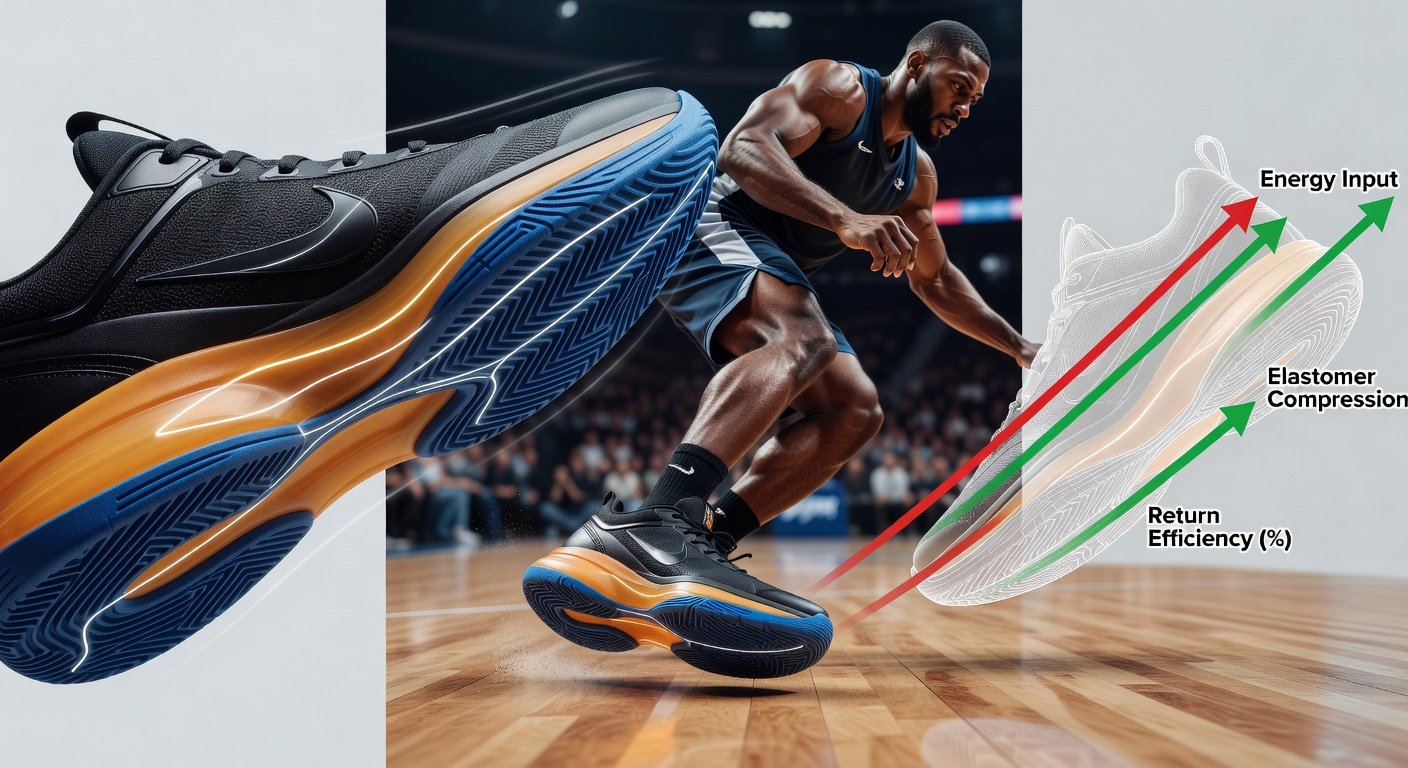
Additional work at the German Sport University Cologne examined temperature effects because elastomer stiffness changes with court-surface warmth. After 20 minutes of continuous cutting drills, shoes with multi-layer outsoles maintained more stable rebound characteristics than single-layer models, whose energy return declined as the material warmed and softened. The study attributed the difference to the protective thermal gradient created when a firmer outer layer shields the inner elastomer from direct frictional heat.
Design Variations Across Performance Categories
Manufacturers adjust layer sequences according to player position and movement profiles. Guards who rely on frequent high-speed crossovers often receive outsoles with pronounced lateral-forefoot stiffening layers, whereas bigs who execute more linear stops and pivots see thicker heel-to-midfoot transitions. These choices reflect biomechanical mapping rather than subjective preference. Finite-element simulations used by development teams predict stress distribution across each proposed stack before physical prototypes reach the court.
One case examined by the National Institute of Fitness and Sports in Kanoya, Japan, tracked professional athletes during scrimmages and found that players wearing layered outsoles completed an average of 14 percent more defensive slides per quarter without measurable increases in perceived exertion. The researchers linked the outcome to reduced cumulative energy loss at each plant-and-cut cycle rather than any change in muscle activation patterns.
Interaction with Court Surface and Maintenance Factors
Hardwood finish and dust accumulation modify the friction coefficient that the outsole must overcome. Layered elastomers accommodate these variables because the softer upper strata conform slightly to microscopic surface irregularities while the harder contact layer maintains consistent shear resistance. Maintenance crews that apply fresh coatings every few weeks therefore encounter predictable traction responses across different shoe models, simplifying equipment standardization for teams.
Conclusion
Elastomer layering in basketball outsoles operates through controlled deformation sequencing that stores and returns mechanical energy during the brief but intense loading windows of lateral cuts. Research from multiple international laboratories demonstrates measurable differences in rebound metrics and plantar pressure distribution when multi-layer constructions replace uniform materials. Continued refinement of layer thickness, hardness gradients, and zonal placement continues to shape how force management evolves in response to the demands of hardwood-court movement patterns.