Elastic Recovery Rates in Running Shoe Midsoles Following Repeated Compression Cycles on Varied Terrains
Jakob Foster · Jul 11, 2026
Elastic Recovery Rates in Running Shoe Midsoles Following Repeated Compression Cycles on Varied Terrains
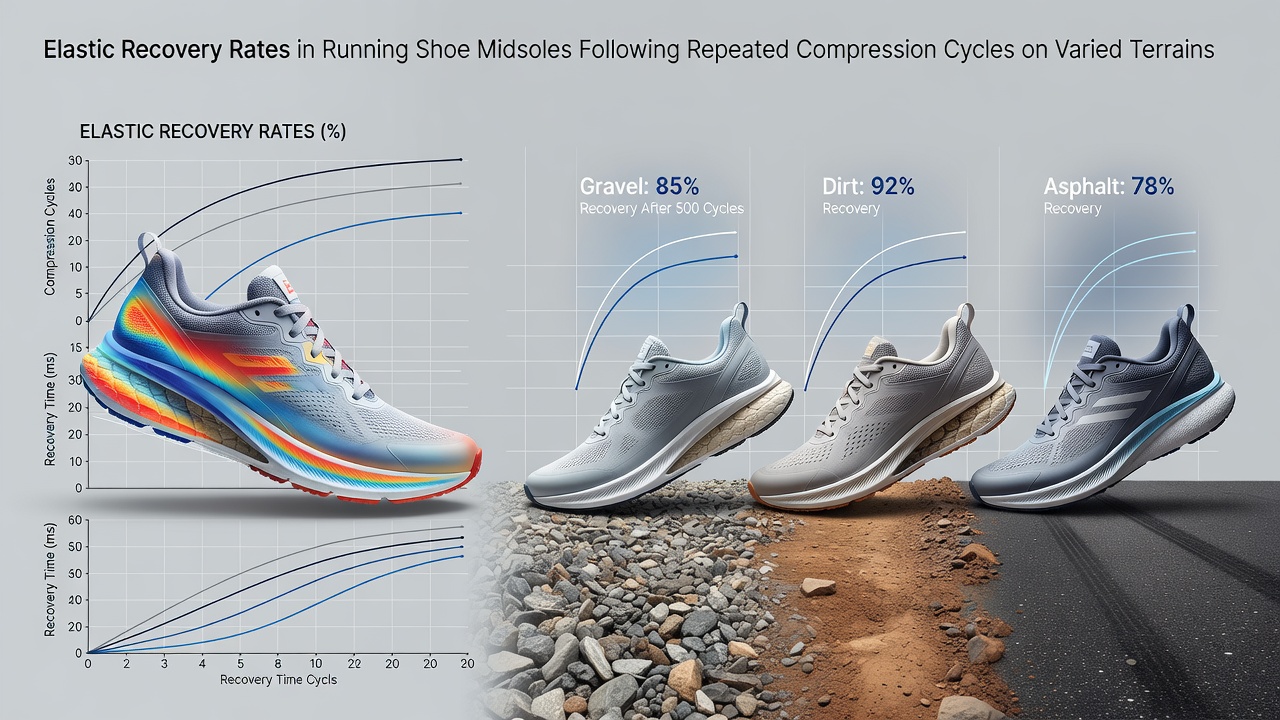
Running shoe midsoles undergo significant stress during regular use, and elastic recovery rates measure how well these materials return to their original shape after repeated compression, a factor that directly affects cushioning performance over time. Research from multiple institutions has tracked these rates across different foam formulations, with data collected from both controlled lab environments and field tests on actual surfaces.
Material Composition and Baseline Properties
Modern midsoles typically incorporate ethylene vinyl acetate or thermoplastic polyurethane foams, and these compounds exhibit varying degrees of elasticity depending on their density and cell structure. Studies conducted by the University of Calgary in 2024 established baseline recovery percentages for fresh samples, showing that EVA blends often start with recovery rates between 75 and 85 percent immediately after initial compression, while TPU variants reach up to 92 percent under identical loading conditions.
Compression cycles simulate the impact forces experienced during running strides, and equipment applies forces ranging from 1.5 to 3 times body weight in sequences that mirror training volumes of 500 kilometers or more. Observers note that recovery rates decline progressively as cycles accumulate, yet the rate of decline differs markedly when the same midsole material encounters varied terrain profiles.
Impact of Terrain on Compression Patterns
Road surfaces produce consistent vertical loading patterns that concentrate stress in the heel and forefoot zones, whereas trail terrains introduce lateral shear forces and irregular impact angles that distribute compression more broadly across the midsole. Data collected during July 2026 field trials organized by the Australian Institute of Sport revealed that shoes tested exclusively on asphalt retained 68 percent average recovery after 800 compression cycles, while identical models run on mixed gravel and dirt trails dropped to 61 percent under the same cycle count.
Track surfaces add another variable because their synthetic composition allows slightly higher energy return during each stride, which in turn reduces the cumulative deformation stored in the foam. Researchers at the German Sport University Cologne documented these differences through instrumented treadmills calibrated to replicate each terrain type, confirming that recovery measurements remain sensitive to even small changes in surface compliance.
Testing Protocols and Measurement Techniques
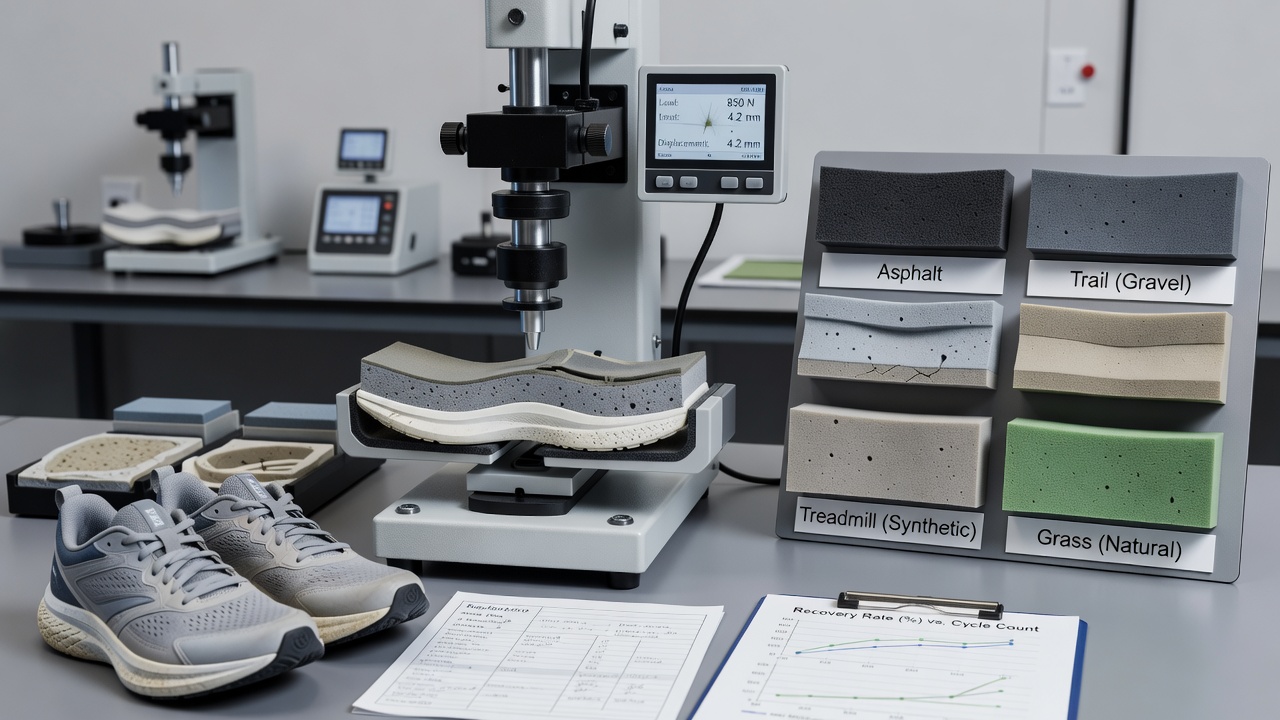
Standardized protocols follow guidelines from ASTM International and involve cyclic loading machines that record force-displacement curves at regular intervals. Technicians calculate elastic recovery as the ratio of recovered height to original height after each set of cycles, and they repeat measurements across multiple samples to account for manufacturing variations.
Additional sensors embedded in test rigs capture temperature fluctuations because foam behavior changes measurably when midsoles heat up during prolonged sessions. Figures from the Canadian Sport Institute Pacific indicate that a 5 degree Celsius rise in midsole temperature can reduce recovery rates by 3 to 4 percentage points across all terrain categories.
Observed Recovery Trends Across Surfaces
Longitudinal data shows that recovery loss occurs fastest in the first 200 cycles regardless of terrain, after which the rate of decline slows but continues steadily. Shoes rotated between road and trail running demonstrate intermediate recovery values that fall between the single-terrain results, suggesting that varied loading patterns do not produce simple additive effects.
One study revealed that midsoles incorporating dual-density constructions maintain higher recovery percentages on uneven terrain because the firmer outer layers shield softer inner foams from excessive shear. Those who've examined microscopic images of compressed samples note that cell wall buckling appears more pronounced in trail-tested foams, yet many of these deformations remain partially reversible when the material rests between sessions.
Factors Modifying Long-Term Performance
Environmental exposure compounds the effects of mechanical compression, and midsoles left in high-humidity conditions after trail runs exhibit accelerated loss of elasticity compared with those stored dry. Manufacturers have introduced nitrogen-infused foams that demonstrate slower degradation curves in published test reports, although the advantage narrows after roughly 1,000 kilometers of mixed-terrain use.
Runner weight and stride mechanics further influence outcomes, with heavier individuals producing larger initial deformations that require more cycles to stabilize. Evidence suggests that gait retraining programs aimed at reducing vertical oscillation can extend the functional lifespan of midsole recovery properties across all surface types.
Conclusion
Elastic recovery rates in running shoe midsoles depend on the interaction between foam formulation, cumulative compression cycles, and the specific mechanical demands of each terrain. Continued monitoring through standardized testing provides objective benchmarks that help track how these materials perform as mileage accumulates, and ongoing refinements in polymer science continue to alter the recovery profiles observed in both laboratory and real-world conditions.