Arch Support Configurations in Tennis Footwear and Their Impact on Lateral Stability During Prolonged Baseline Play on Clay Surfaces
Ben Fischer · Jun 9, 2026
Arch Support Configurations in Tennis Footwear and Their Impact on Lateral Stability During Prolonged Baseline Play on Clay Surfaces
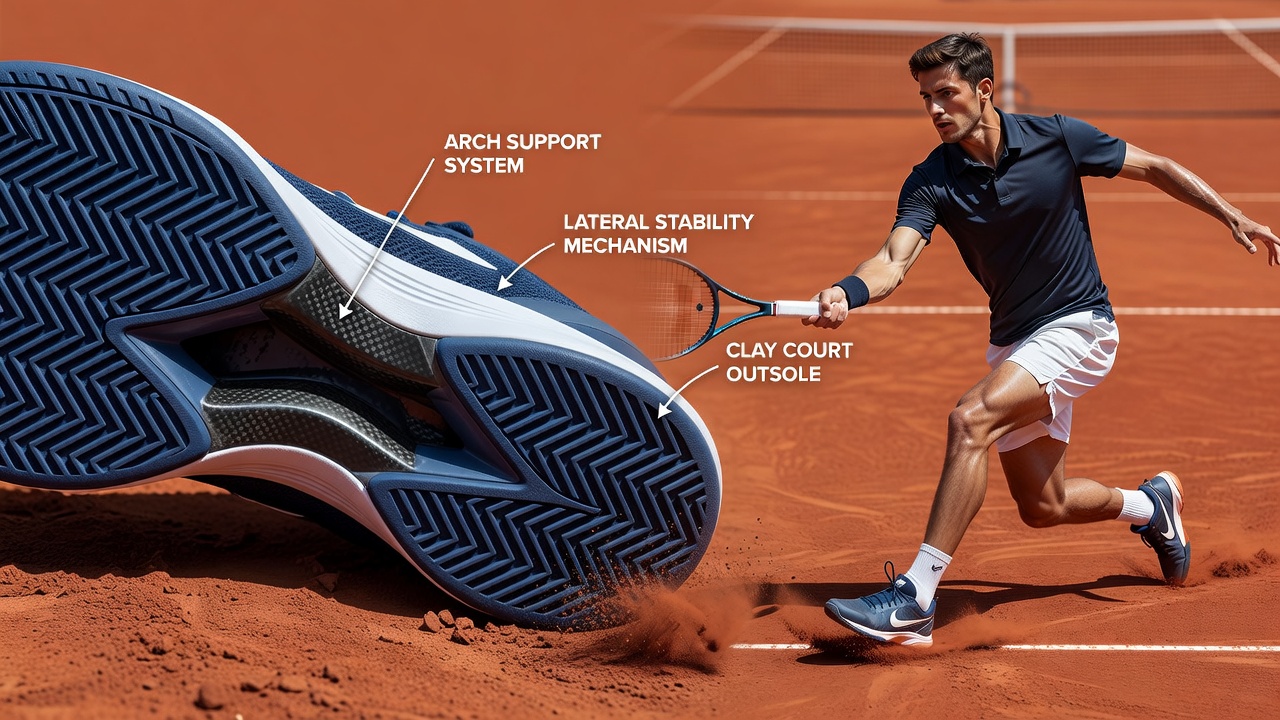
Arch support placements in tennis footwear connect directly to lateral stability when players engage in extended baseline exchanges on clay courts, where sliding movements and repeated directional changes place specific demands on foot mechanics. Researchers have examined how medial, lateral, and central arch configurations influence pronation control and ankle alignment during these prolonged rallies, which often extend beyond thirty minutes on slower clay surfaces.
Clay courts require players to maintain balance while absorbing lateral forces that arise from sliding stops and explosive recoveries. Data from biomechanical studies indicate that arch support positioned along the medial side of the midsole can reduce excessive inward rolling of the foot, whereas placements shifted toward the lateral edge help limit outward rolling during side-to-side movements. Observers note that these adjustments become particularly relevant when rallies stretch into multiple exchanges because fatigue gradually alters gait patterns and increases reliance on footwear structure for stability.
Placement Variations and Their Biomechanical Roles
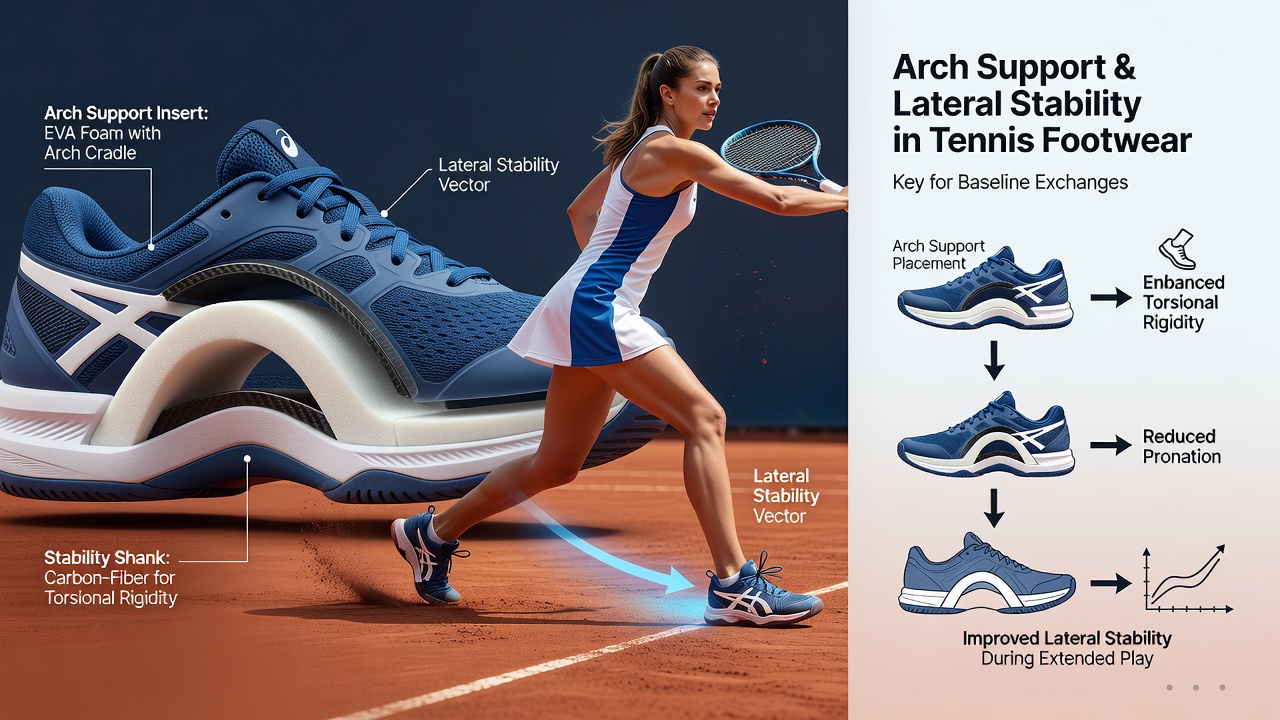
Manufacturers position arch supports in several distinct configurations within tennis shoes intended for clay play. A full-length medial arch support extends from the heel through the forefoot and provides continuous contact along the inner foot edge, while a contoured lateral support focuses pressure distribution on the outer midfoot region. Central placements, often combined with variable-density foam, sit directly beneath the longitudinal arch and allow slight compression that accommodates both pronation and supination cycles.
Studies conducted by the Australian Institute of Sport have measured how these placements affect ground reaction forces during simulated clay-court movements. Findings reveal that medial-dominant supports correlate with reduced peak lateral shear forces at the ankle joint when players execute recovery steps after wide baseline shots. In contrast, lateral-dominant supports show measurable effects on limiting supination angles during split-step landings on loose clay particles.
Clay Court Dynamics and Extended Baseline Exchanges
Baseline exchanges on clay involve repeated lateral accelerations followed by controlled slides that differ from the abrupt stops seen on hard courts. The surface friction allows longer contact times between shoe and court, which transfers more sustained lateral loads through the midfoot. When rallies continue for many shots, small instabilities in arch support can accumulate into noticeable shifts in knee and hip alignment.
Performance testing completed in June 2026 at several European training facilities documented foot pressure maps from professional players during match simulations lasting ninety minutes. The data showed that shoes with integrated medial arch reinforcements maintained more consistent center-of-pressure paths under the forefoot throughout the later stages of these sessions. Players wearing models with minimal lateral support exhibited greater variability in lateral foot pressure as match duration increased.
Material Interactions and Support Integration
Modern tennis footwear combines arch support elements with midsole foams that respond differently to clay-induced moisture and temperature changes. Thermoplastic polyurethane inserts placed under the arch retain stiffness longer than traditional EVA foams when exposed to the damp conditions common on clay courts. These material choices work together with placement geometry to preserve lateral stability even after repeated cycles of compression and recovery.
Industry reports from the International Tennis Federation outline testing protocols that evaluate how arch support placements interact with outsole patterns specifically engineered for clay. The protocols measure torque resistance and lateral displacement under loads that replicate extended baseline movement patterns. Results from these standardized tests help manufacturers refine support positioning before shoes reach retail markets.
Research Developments and Player Monitoring
Recent collaborations between university biomechanics departments in Canada and professional training centers have introduced wearable sensors that track real-time arch compression during clay-court sessions. These devices record how different support placements influence ankle inversion angles when players transition between defensive slides and offensive recoveries. Early datasets suggest that hybrid placements combining medial stiffness with moderate lateral flexibility produce the most balanced pressure distribution across long exchanges.
Equipment specialists continue to analyze how arch support geometry interacts with sockliner thickness and upper construction. Adjustments in one component often require recalibration of others to maintain overall lateral stability on clay, where surface variability adds another layer of complexity to foot-shoe-court interactions.
Conclusion
Arch support placements in tennis footwear demonstrate clear connections to lateral stability during extended baseline exchanges on clay courts through their influence on foot alignment, pressure distribution, and force absorption. Ongoing research from multiple regions continues to refine understanding of optimal configurations, with testing data guiding design adjustments that address the specific demands of prolonged clay-court movement patterns.